Friday, March 22, 2013

Wednesday, March 20, 2013
Lit Terms
Omniscient Point of View:
knowing all things, usually the third person

Onomatopoeia: use of a word whose sound in some degree
imitates or suggests its meaning.

Oxymoron: a figure of speech in which two contradicting
words or phrases are combined to produce a rhetorical effect by means of a
concise paradox .

Pacing: rate of
movement; tempo.

Paradox: a statement
apparently self-contradictory or absurd but really containing a possible truth;
an opinion contrary to generally accepted ideas.


Personification: a figure of speech attributing human qualities to inanimate objects or abstract ideas.

Plot: a plan or scheme to accomplish a purpose. 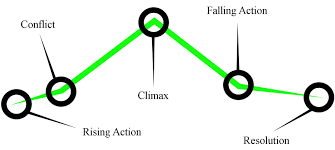

Poignant: eliciting
sorrow or sentiment.

Point of View: the attitude unifying any oral or written argumentation; in description, the physical point from which the observer views what he is describing.
Postmodernism: literature characterized by experimentation, irony, nontraditional forms, multiple meanings, playfulness and a blurred boundary between real and imaginary.
Prose: the ordinary
form of spoken and written language; language that does not have a regular
rhyme pattern.
Protagonist: the central character in a work of fiction;
opposes antagonist.
Pun: play on words;
the humorous use of a word to emphasize different meanings.
Purpose: the intended result wished by an author.
Realism: writing about the ordinary aspects of life in a
straightforward manner to reflect life as it actually is.
Refrain: a phrase or verse recurring at intervals in a poem
or song; chorus.
Requiem: any chant, dirge, hymn, or musical service for the
dead.
Resolution: point in a literary work at which the chief
dramatic complication is worked out; denouement.
Restatement: idea repeated for emphasis.
Rhetoric: use of language, both written and verbal in order
to persuade.
Rhetorical Question:: question suggesting its own answer or
not requiring an answer; used in argument or persuasion.
BNW Essay Intro Just
I hate my writing so much...
The separation of Savage and Civilization illuminates The
Brave New World’s ignorance and contorted morals. To leer and scoff at
something individual and self-sustained such as the savage’s existence proves
the need for structure and loss of individuality within “civilized” society. The
savage shows the reader that brainwashed, drugged, and judgmental society can
be acceptable if it’s part of the majority’s way of life. We value the name
brand regardless if another product is more effective; the savage is the store
brand, not well known and not popular but still a big part of how society
functions as a whole.
Sunday, January 27, 2013
Lit Terms 1-5
Allegory- A story that uses symbols to make a point.

Alliteration- The repetition of similar initial sounds in a group of words.

Allusion - A reference to a person, place, event, or literary work that the reader expects the reader to recognize.
(Animal Farm & the Russian Revolution)


Ambiguity- Something uncertain as to interpretation.
(Side of a beautiful young woman... or an old woman's face)

Anachronism- Something that shows up at the wrong place or the wrong time.
(Medieval cell phones?)

Alliteration- The repetition of similar initial sounds in a group of words.
Allusion - A reference to a person, place, event, or literary work that the reader expects the reader to recognize.
(Animal Farm & the Russian Revolution)
Ambiguity- Something uncertain as to interpretation.
(Side of a beautiful young woman... or an old woman's face)
Anachronism- Something that shows up at the wrong place or the wrong time.
(Medieval cell phones?)
S.M.A.R.T. Goal :)
S.pecific- Get a Special Intelligence rating in the United
States Navy
M.easurable- Rank up to E-9 by my 15th year of
service and become a SI officer in the Navy
A.ttainable- Joining the service is a process but is
definitely possible for myself
R.e-enforceable- Get my tattoos removed through the Liberty
Program, get a great score on the ASVAB by studying the subjects of the test,
then wait until I get shipped off to Bootcamp
T.imely- I’m legally able to join once I graduate with my GED
as long as I have my tattoos removed, then I just have to wait until they ship
me off for Bootcamp
Wednesday, January 2, 2013
What's In It For Me?
I think this title is misleading... because now instead of just reading this post to read it, you're now doing so expecting something I just am not willing to deliver. I'm doing this assignment because I "want an A" to quote Preston's do not quote these cliches post. What I really want from the next 6months in this English class is to get my credits and graduate so I can follow my dreams. If not simply so I can be gone and done with this prison yard disguised as a school to move toward my military service, I'm in this class because I don't want to be bored out of my mind... not that I haven't been while attending. If you want to know what I wish to accomplish in the next 6months FROM this class, well....you're shit out of luck, because I have no clue. I just want to be me and move on with my life.
Subscribe to:
Posts (Atom)